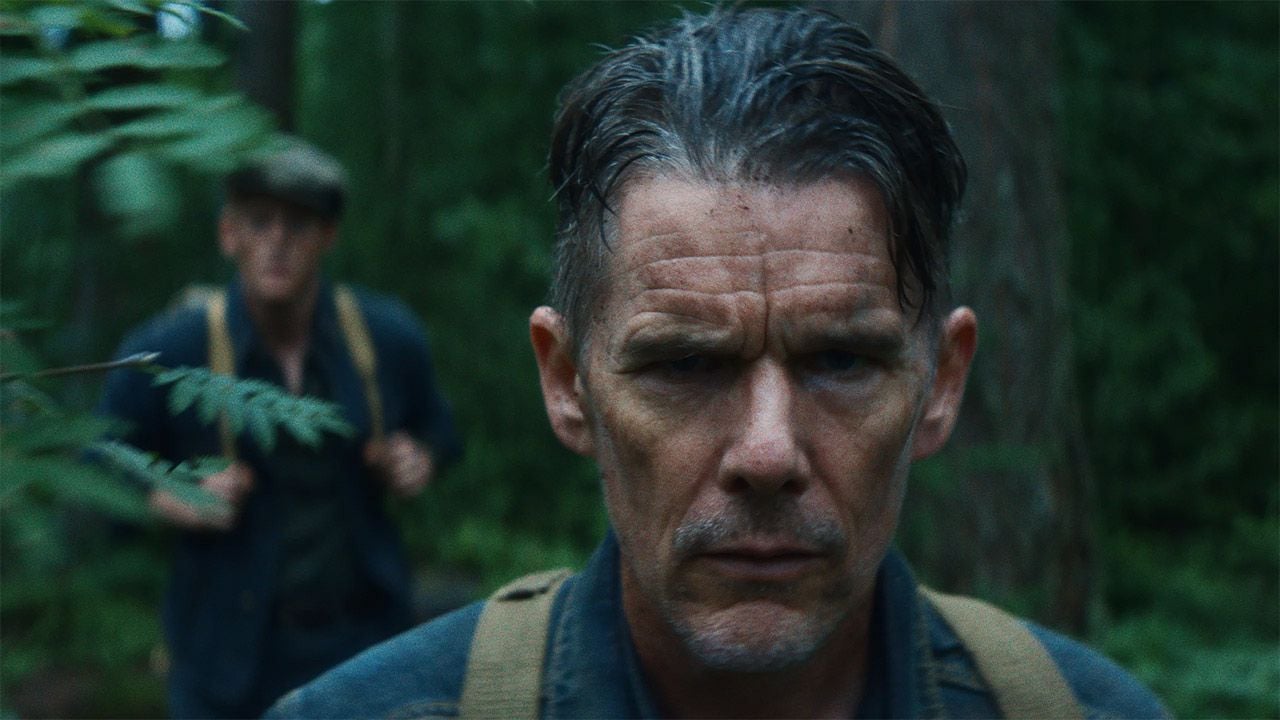
The much-anticipated pairing of Oscar-nominated Ethan Hawke and Oscar-winner Russell Crowe marks a significant cinematic event, bringing together two actors renowned for their powerful screen presence. The film, set against the backdrop of the Great Depression in 1933, centers on Samuel Murphy (Hawke), a man torn from his daughter and forced into a brutal labor camp after his wife's death. His only path to freedom and reunion with his child lies in a treacherous gold smuggling mission orchestrated by a ruthless supervisor, Clancy (Crowe).
Director Padraic McKinley, making his feature film debut, was instrumental in uniting the stars. He had previously worked with both actors independently – Hawke on the series The Good Lord Bird and Crowe on The Loudest Voice and The Exorcism. McKinley told Allociné that he was captivated by their talent: "I had just worked with both of them and was completely blown away by their respective performances and by our creative chemistry." This prior collaboration inspired him to envision Crowe as the antagonist while developing the script with Hawke, setting the stage for their dynamic on-screen confrontation.
The cast is further bolstered by talents like Austin Amelio, Avi Nash, and Julia Jones. McKinley made a conscious effort to ensure strong female representation in a story predominantly featuring men, highlighting Jones' character, Anna. The director expressed his astonishment at assembling such a caliber of actors for his first feature, particularly given the production's budget.
Gold Run is deeply rooted in its historical setting, exploring the economic turmoil of the Great Depression when the U.S. government confiscated gold, making any hidden reserves incredibly valuable. McKinley aimed to immerse audiences in this turbulent and fascinating period of American history. The film also draws heavily from classic 1970s adventure cinema, with McKinley citing influences like William Friedkin's Sorcerer (known in French as Le Convoi de la peur). Visually, the director looked to the westerns of Sergio Leone and Clint Eastwood, while his directorial approach was informed by masters such as Sidney Lumet and Peter Weir.
Remarkably, the film's rugged Oregon landscapes were brought to life in Bavaria. McKinley explained that the often-gloomy weather during filming contributed to the film's unique and haunting atmosphere, finding immense inspiration in the Bavarian locations. This commitment to authenticity extends to the film's core philosophy: an action-packed narrative that never sacrifices emotional depth. McKinley articulated his vision for the film as: "That kind of courage. That kind of sweat. That kind of poetry."
At its heart, Gold Run is a poignant story about family and hope. Murphy's bond with his daughter is the driving force behind his perilous journey, a theme McKinley, himself a father of two, wanted to place front and center. He also noted the contemporary resonance of the struggle to provide for family, especially in the wake of global challenges. Despite the relentless hardships, betrayals, and injuries Murphy endures, his humanity and perseverance shine through. McKinley hopes the film inspires viewers, concluding with a powerful sentiment: "Hope itself is a kind of currency, whose value appreciates the longer one holds onto it."
Gold Run promises a gripping cinematic experience, blending tension, action, and profound emotion, with the combined star power of Ethan Hawke and Russell Crowe leading a spectacular and perilous adventure.